Clay Review
AI AutomationAn AI data enrichment and automation platform for sales and GTM teams. Pull lead information in bulk from 150+ data providers.
Editor's Verdict
Clay earns a 4.3/5 rating as one of the more capable options in the ai automation space. Its standout strength — unified access to 150+ data providers — makes it particularly valuable when that capability matters most to your workflow. The main trade-off is paid plans are on the expensive side (starting at $134/mo), which is worth weighing against the alternatives before committing. Because the free plan lets you validate fit without risk, there is very little downside to testing it first.
Table of Contents
What is Clay?
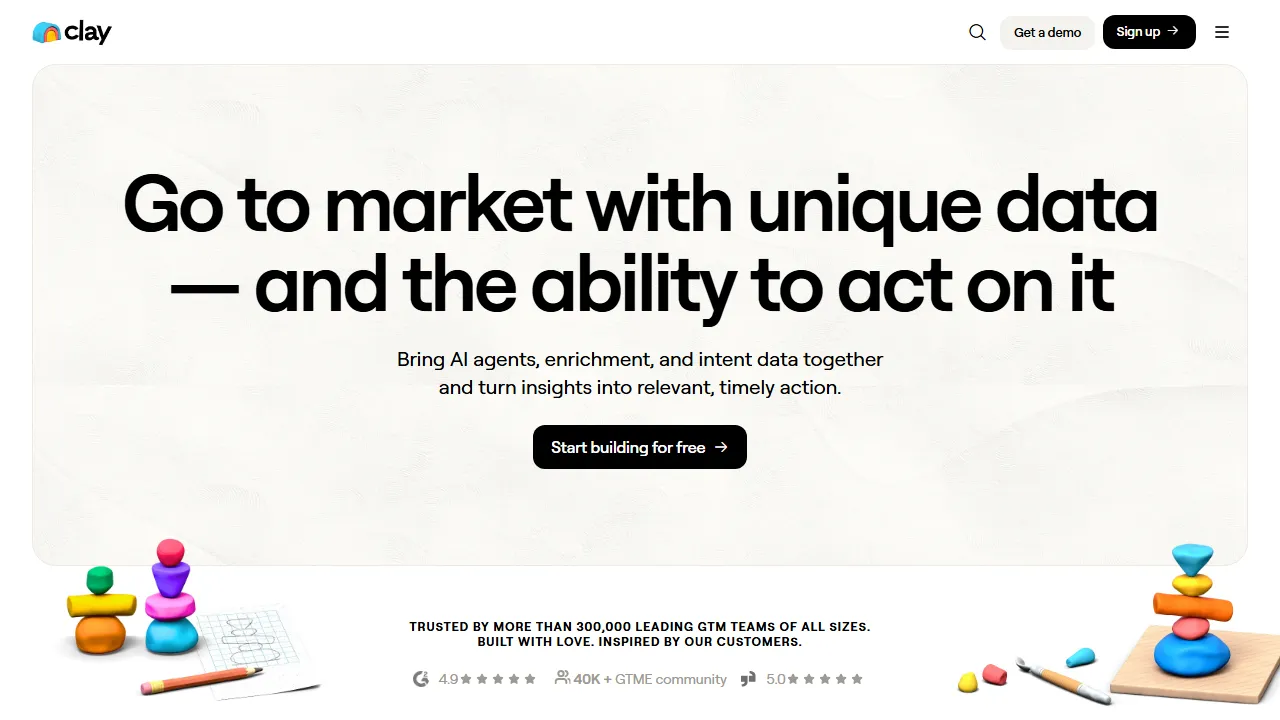
Clay is an AI data enrichment and automation platform designed for sales and GTM (Go-to-Market) teams. It pulls company and contact information in bulk from over 150 premium data providers and enables AI-powered lead scoring, personalized email creation, and automatic CRM updates. Operated through a spreadsheet-like UI, the AI automatically researches and fills in data for each row (lead). Its waterfall enrichment approach automatically searches alternative sources when information isn't found in one data provider, maximizing data coverage. As of 2026, Clay is one of the fastest-growing sales tech platforms.
Who is Clay for?
Clay is best suited for operations teams and business owners looking to streamline repetitive workflows. Its free plan lowers the barrier to entry, making it easy to evaluate before committing. The breadth of features (6+) — including 150+ data provider integrations and Waterfall enrichment — means you rarely need to switch to another tool for related tasks. Users frequently highlight one specific strength: unified access to 150+ data providers.
Pricing plans & value for money
Clay offers the following plans. Prices reflect the latest available information at the time of review and may change; always confirm on the official site before purchasing.
Key features & capabilities
Here is what Clay brings to the table, ranked roughly by how central each capability is to the product experience.
Pros and cons
After evaluating Clay against the rest of the ai automation field, these are the trade-offs that stood out in day-to-day use.
What we liked
- ●Unified access to 150+ data providers
- ●Waterfall enrichment maximizes data coverage
- ●Intuitive spreadsheet-like UI
- ●AI-generated personalized outreach
- ●Unused credits roll over to the next month
What could be better
- ●Paid plans are on the expensive side (starting at $134/mo)
- ●Sales/GTM-focused — not suited for other purposes
- ●Some operations consume many credits, requiring budget management
How to get started with Clay
A practical, five-step path we recommend for anyone evaluating Clay for the first time — designed to minimise wasted time and help you decide fast.
1Sign up for Clay
Head to the official Clay website and create an account. You can start with the free plan without entering payment details, which is ideal for testing how it fits your workflow.
2Set up your workspace
Install the app on web if a native client is available, or simply open it in your browser. Configure basic preferences such as language, notifications, and default output style so that subsequent runs feel consistent.
3Run your first task with 150+ data provider integrations
Start with a small, low-stakes task to understand how Clay responds. Write a clear prompt or input, review the output, and iterate. This low-risk exploration is the fastest way to build intuition for what the tool excels at.
4Integrate into your daily workflow
Once you know its strengths, introduce Clay into one concrete workflow — not ten. Replace one existing step with it and measure the time saved or quality gained over a week before expanding usage further.
5Upgrade based on real usage
Rather than upgrading upfront, monitor which limits you actually hit (message count, output length, export features). Upgrade only when a specific limit blocks your productivity, not because the higher plan looks more attractive on paper.
Best Clay alternatives
Not sure Clay is the right fit? These comparable tools in the ai automation space are worth considering depending on your priorities.
Zapier AI
AI-powered workflow automation platform. Connect over 7,000 apps and achieve advanced business automation with AI.
Offers a comparable editorial rating and a more affordable entry point. Best if you want unmatched integration with over 7,000 apps.
n8n
An open-source workflow automation tool. Features AI agent capabilities with self-hosting support for complete data control.
Offers a comparable editorial rating and a more affordable entry point. Best if you want open source and self-hostable for complete data control.
Activepieces
An open-source automation platform. A Zapier alternative offering 330+ integrations and unlimited task execution.
Offers a comparable editorial rating and a more affordable entry point. Best if you want open-source (mit license) and self-hostable.
Frequently asked questions
Can I use Clay for free?+
Yes, the free plan includes up to 100 credits per month. However, for serious sales activities, the Starter plan ($134/mo) or higher is recommended.
How does it differ from ZoomInfo?+
Clay integrates 150+ data providers, letting you pull data from multiple sources on a single platform. ZoomInfo specializes in its own proprietary database, offering deeper company data.
Can it integrate with CRMs?+
Yes, it integrates with major CRMs including Salesforce, HubSpot, and Pipedrive, automatically syncing enriched data to your CRM.
Ready to try Clay?
Start with the free plan — no credit card required.
Start with Clay →More AI Automation Tools
Zapier AI
AI-powered workflow automation platform. Connect over 7,000 apps and achieve advanced business automation with AI.
Make(旧Integromat)
A platform that automates workflows with a visual builder. Features AI capabilities with 1,800+ app integrations for building complex automation scenarios.
n8n
An open-source workflow automation tool. Features AI agent capabilities with self-hosting support for complete data control.
Bardeen AI
A browser extension-based AI automation tool. Automates data collection, form filling, and sales activities with 200+ app integrations.
Activepieces
An open-source automation platform. A Zapier alternative offering 330+ integrations and unlimited task execution.
Pipedream
A developer-focused API integration and automation platform. Build flexible workflows combining code execution and no-code actions.
Reviewed by: AIpedia Editorial Team · Last updated: October 26, 2026 · Methodology: How we test & rate
This review reflects our editorial opinion based on hands-on testing, pricing verification, and cross-referencing with official documentation. We do not accept payment in exchange for favourable reviews. Read our full editorial policy.