Polymer Review
AI Data AnalyticsTransform spreadsheet data into interactive dashboards with AI.
Editor's Verdict
Polymer earns a 3.9/5 rating as one of the more capable options in the ai data analytics space. Its standout strength — instant dashboards from spreadsheets — makes it particularly valuable when that capability matters most to your workflow. The main trade-off is limitations with large-scale data, which is worth weighing against the alternatives before committing. Because the free plan lets you validate fit without risk, there is very little downside to testing it first.
Table of Contents
What is Polymer?
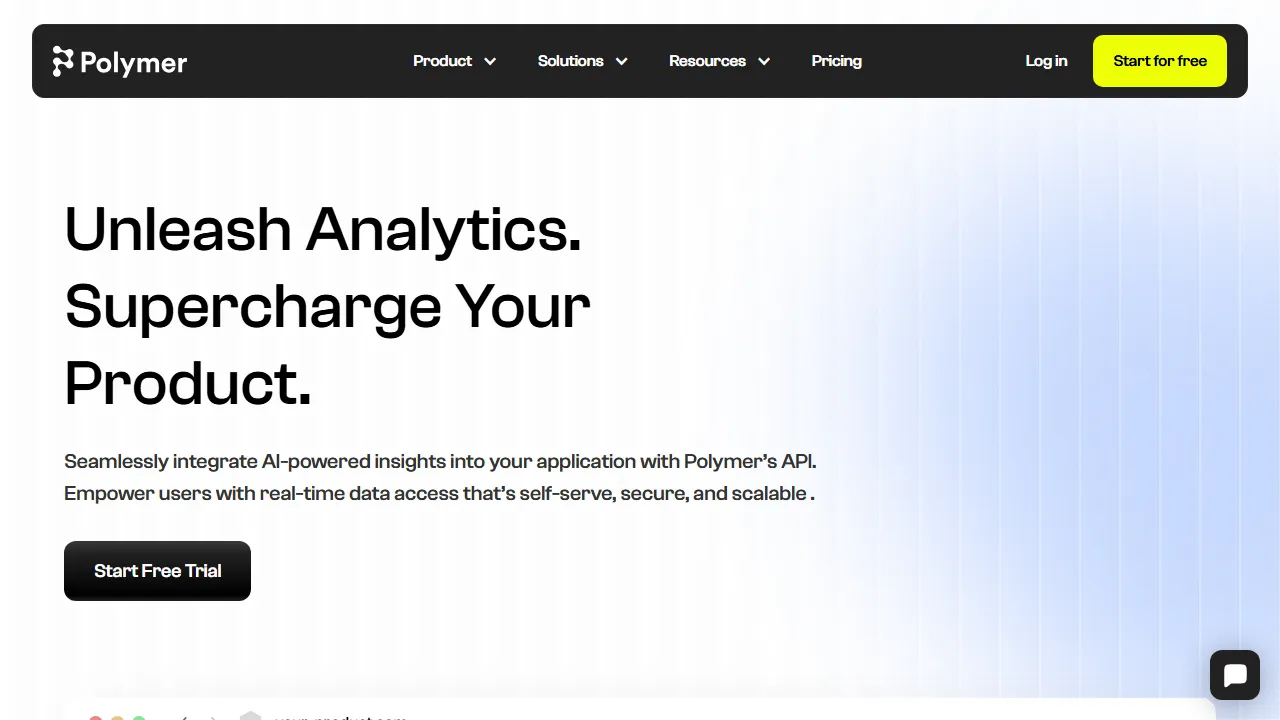
Polymer is a tool that uses AI to analyze spreadsheet data from Google Sheets, Excel, CSV, and other sources, automatically converting it into interactive dashboards. Simply load your data and the AI suggests optimal charts and graphs, instantly generating dashboards with filtering and drill-down capabilities. No data analysis expertise is required to gain visual insights.
Who is Polymer for?
Polymer is best suited for data analysts, business intelligence teams, and decision-makers who work with large datasets. Its free plan lowers the barrier to entry, making it easy to evaluate before committing. A focused feature set centered on AI dashboard generation and Auto chart suggestions keeps the experience streamlined rather than overwhelming. Users frequently highlight one specific strength: instant dashboards from spreadsheets.
Pricing plans & value for money
Polymer offers the following plans. Prices reflect the latest available information at the time of review and may change; always confirm on the official site before purchasing.
Key features & capabilities
Here is what Polymer brings to the table, ranked roughly by how central each capability is to the product experience.
Pros and cons
After evaluating Polymer against the rest of the ai data analytics field, these are the trade-offs that stood out in day-to-day use.
What we liked
- ●Instant dashboards from spreadsheets
- ●No-code operation
- ●Sharing and embedding features
What could be better
- ●Limitations with large-scale data
- ●Advanced statistical analysis not available
- ●Japanese UI not supported
How to get started with Polymer
A practical, five-step path we recommend for anyone evaluating Polymer for the first time — designed to minimise wasted time and help you decide fast.
1Sign up for Polymer
Head to the official Polymer website and create an account. You can start with the free plan without entering payment details, which is ideal for testing how it fits your workflow.
2Set up your workspace
Install the app on web if a native client is available, or simply open it in your browser. Configure basic preferences such as language, notifications, and default output style so that subsequent runs feel consistent.
3Run your first task with AI dashboard generation
Start with a small, low-stakes task to understand how Polymer responds. Write a clear prompt or input, review the output, and iterate. This low-risk exploration is the fastest way to build intuition for what the tool excels at.
4Integrate into your daily workflow
Once you know its strengths, introduce Polymer into one concrete workflow — not ten. Replace one existing step with it and measure the time saved or quality gained over a week before expanding usage further.
5Upgrade based on real usage
Rather than upgrading upfront, monitor which limits you actually hit (message count, output length, export features). Upgrade only when a specific limit blocks your productivity, not because the higher plan looks more attractive on paper.
Best Polymer alternatives
Not sure Polymer is the right fit? These comparable tools in the ai data analytics space are worth considering depending on your priorities.
Akkio
No-code AI data analytics and prediction platform. Built for business predictive analytics.
Offers a comparable editorial rating at a higher price point. Best if you want build prediction models without code.
MonkeyLearn
AI tool specialized in text analysis. Perform sentiment analysis, classification, and entity extraction with no code.
Offers a slightly lower editorial rating at a higher price point. Best if you want specialized in text analysis.
Obviously AI
No-code AI platform for building machine learning models. Simply upload data to auto-build predictive models for business forecasting.
Offers a slightly higher editorial rating at a higher price point. Best if you want build and deploy machine learning models without code.
Frequently asked questions
What data sources are supported?+
Polymer supports Google Sheets, Excel, CSV, Airtable, Shopify, Stripe, and other data sources.
Can I share the dashboards I create?+
Yes, you can share dashboards via URL or embed them on websites.
Ready to try Polymer?
Start with the free plan — no credit card required.
Start with Polymer →More AI Data Analytics Tools
Julius AI
AI tool for natural language data analysis. Simply upload CSV or Excel files to auto-generate charts, statistical analyses, and predictive models.
Tableau AI
AI features integrated into Salesforce's BI tool Tableau. AI assists with data visualization and analysis, automatically discovering insights.
Obviously AI
No-code AI platform for building machine learning models. Simply upload data to auto-build predictive models for business forecasting.
Akkio
No-code AI data analytics and prediction platform. Built for business predictive analytics.
Dataiku
Enterprise AI data analytics platform. Democratizing data science for organizations.
MonkeyLearn
AI tool specialized in text analysis. Perform sentiment analysis, classification, and entity extraction with no code.
Reviewed by: AIpedia Editorial Team · Last updated: October 26, 2026 · Methodology: How we test & rate
This review reflects our editorial opinion based on hands-on testing, pricing verification, and cross-referencing with official documentation. We do not accept payment in exchange for favourable reviews. Read our full editorial policy.